Homeland Ridge yesterday unveiled a new system to alert government,
law enforcement and the public to the risk of terrorist attacks, even as
he acknowledged that it could be many years before the country is secure
enough to enjoy the lowest warning level.
The five-level, color-coded system was crafted to reduce the confusion caused by a series of vaguely worded alerts issued by the federal government since the Sept. 11 terrorist attacks. Many officials said the alerts did little more than alarm the public.
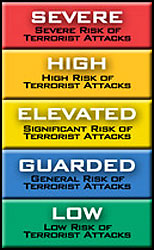
The "Homeland Security Advisory System" issued yesterday has warning levels that range from green, for a low risk of terrorist attacks, to red, which signifies a severe threat. For now, Ridge said, the entire country is on a yellow, or elevated, alert, the midpoint of the spectrum.
Despite the military campaign in Afghanistan and enhanced security measures, Ridge said, al Qaeda operatives continue to target the United States, and there is a "fairly high" likelihood that some remain within U.S. borders, waiting to strike.
Ridge said the United States would remain on the elevated alert status "for the foreseeable future," conceding that he could not predict when the warning level might be downgraded to green.
"Even in a low level of risk, there's a recognition that the possibility or the potential of a terrorist attack still exists in the world today," Ridge told reporters. "And that, I think, is a permanent condition in the world. Whether or not we ever get to low, I'm hopeful, but I still think it's years away."
Despite months of planning, the system remains a work in progress. The plan doesn't say exactly what communities are supposed to do as risks escalate, providing general guidance but deferring to the judgment of local officials. And, while the federal government is adhering to the plan, state and local governments and the private sector cannot be required to take part.
In the next several months, Ridge said, state and local governments, as well as private businesses, will decide how to respond to each of the color-coded alert categories so that over time, the entire nation will share a "common language" of homeland security. States and cities will provide instructions to the public on what to do at each threat level.
In the meantime, the plan contains some general guidance, ranging from making routine security checks to closing government buildings. Ridge said the system not only informs the public but also could deter terrorists from acting.
The U.S. Conference of Mayors, the National League of Cities, the Business Roundtable, the American Trucking Associations and other organizations praised the plan for providing a clearer sense of terrorism risks and said they would provide feedback within a 45-day public comment period.
Former attorney general Edwin Meese III, who recently led a Heritage Foundation study on homeland security, said the effort is "a very good step in providing detailed information to the officials who need to know and also bringing some clarity to the public."
Rep. Jane Harman (D-Calif.) agreed that the system is "a step in the right direction" but warned that its effectiveness depended on the information behind it. She said that she hoped the FBI and other agencies would share that information with local officials to give them a more complete picture of the terrorist threat.
"Homeland security is not as simple as red light, green light," Harman said. "But I do think red light, green light can play an important role in homeland security."
State and local officials also reacted warmly to the changes.
In Washington state, Maj. Gen. Timothy J. Lowenberg, who leads the National Guard and coordinates state homeland security efforts, said the defined levels will be "incredibly helpful" because the message and response will be consistent and synchronized. D.C. Mayor Anthony A. Williams (D) said the system "gives us a predictability we need to protect our citizens against the threats we face."
Until now, Charlotte Mayor Pat McCrory (R) said, "we really had no degree of information as to how to advise our citizens. On some of the alerts, citizens would maybe not go to work, or not go to school, or quit flying. And that wasn't the initial intent."
The plan calls for Attorney General John D. Ashcroft to set the alert levels, based on intelligence gathered by the CIA, FBI and other agencies, after consulting with Ridge and other top government officials. Except in extreme circumstances -- such as when authorities are on the verge of making a major arrest -- Ridge said he expected Ashcroft to communicate information about changes in the threat status to the public.
Though he acknowledged that the new system is "a little science . . . and a lot of art," Ridge, in a speech yesterday to law enforcement officials, described a checklist used to weigh intelligence and set appropriate risk levels.
"Is it credible?" he asked. "Is it a credible source? Have we been able to corroborate this threat? Is it specific as to time or place or method of attack? What are the consequences if the attack is carried out? Can the attack be deterred?"
Ridge, who was governor of Pennsylvania before Bush tapped him to lead the homeland security effort in October, took on the task of designing the new alert system as one of his first priorities. He moved cautiously, convening a series of meetings with federal, state and local government leaders, police chiefs and military officials, saying that the plan's success depended upon everyone going along with it.
The system was modeled after the military's progressive DefCon, or defense condition, threat scale, which will remain in effect for the armed forces.